UX & CRO Design
Woolroom UX/CRO Optimisation
Optimised Woolroom’s key conversion pages' experience through research driven UX and CRO experimentation to improve conversion, clarity, usability, and overall engagement.
Year :
2025
Industry :
Ecommerce
Client :
Woolroom
Project Duration :
2 months
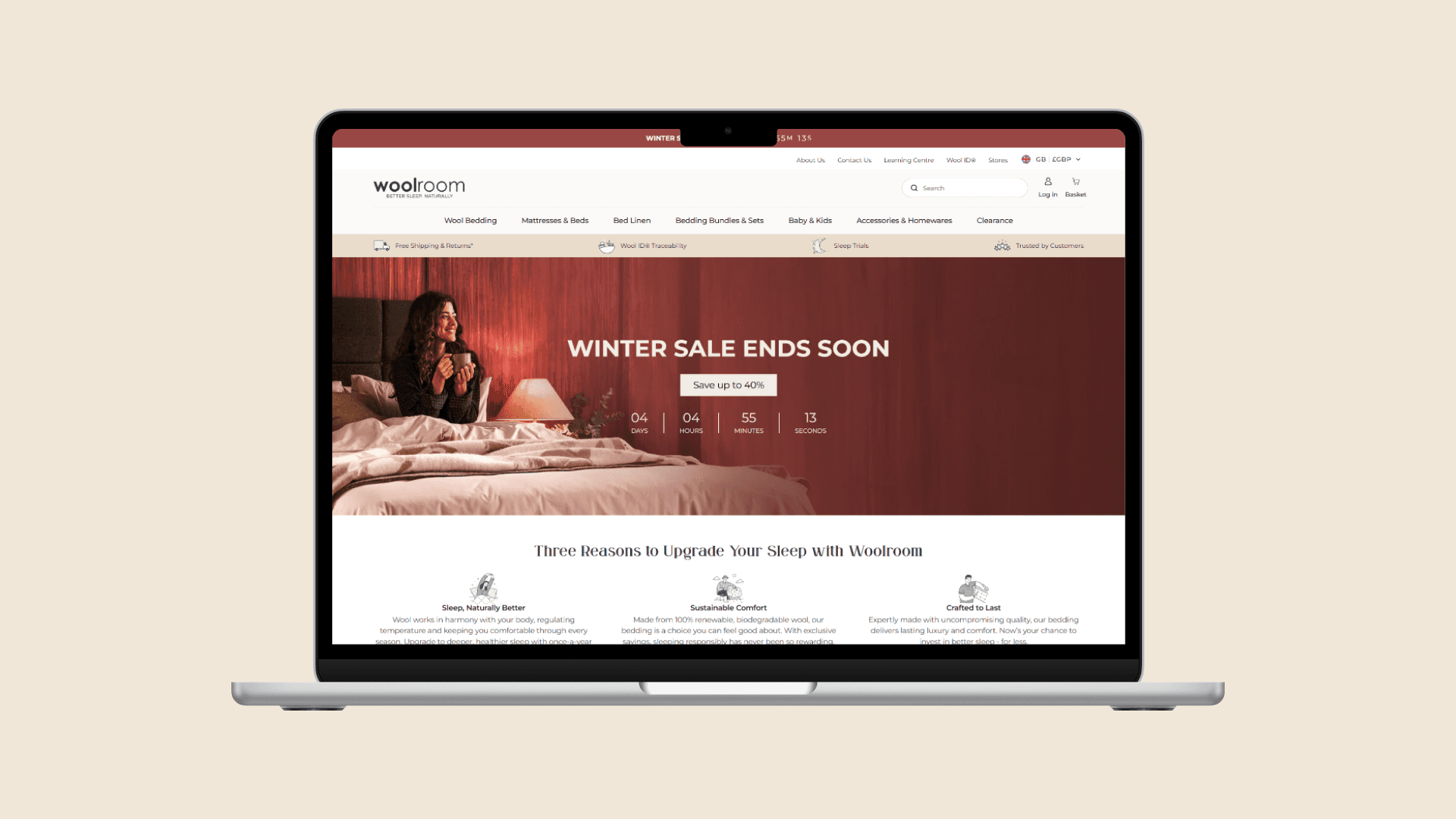
Overview:
As a UX & CRO Strategist, I worked with Woolroom, a luxury bedding e-commerce brand, to improve conversion performance across key revenue pages. Using a combination of behavioural analytics, UX research, and experimentation, I generated and tested over 20 UX/CRO hypotheses. Each test focused on reducing friction, improving product clarity, and making purchasing decisions easier for customers across the UK, US, and Canadian markets.
This project demonstrates my ability to combine research, UX design, and experimentation to drive measurable business outcomes.
Objectives:
Reduce friction
Improve the product configuration experience by simplifying variant selection and surfacing important information earlier in the decision process.
Increase visibility
Ensure users could clearly see pricing changes and available options when switching between duvet variants.
0+
0+
UX/CRO hypotheses were created, client approved, and tested.
Key actions:
Conducted behavioural analysis using GA4 and session recordings to identify product page friction.
Designed and validated new UX patterns for variant selection and product configuration.
Led UX experimentation and A/B testing to validate improvements before full deployment.
From left to right, this is the UX /CRO process I took for each client:
Behavioural Data Analysis
Analysed GA4 and Microsoft Clarity data to understand how customer interaction and identify friction points.
UX Heuristic Evaluation
Conducted heuristic reviews of revenue generating pages to uncover usability issues and conversion barriers.
Qualitative Research
Developed personas, user journey maps, surveys, and competitor reviews to understand purchase motivations.
Hypothesis Generation
Converted insights into structured CRO hypotheses and prioritised them using expected impact and effort.
Design & Experimentation
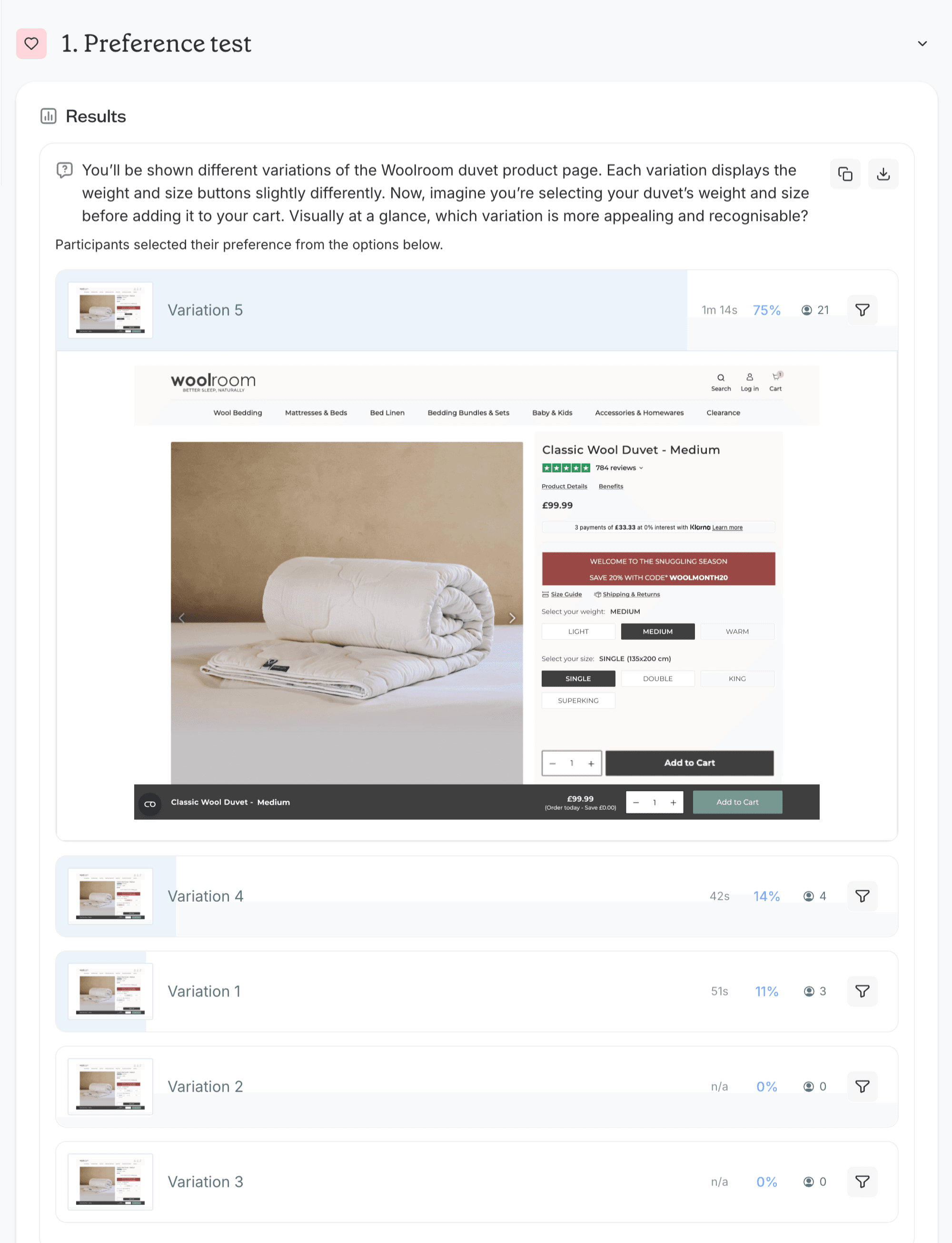
Created multiple UX design variations and tested them through offline preference testing across Woolroom’s UK, US, and Canadian audiences.
A/B Testing & Validation
Built and launched experiments using Varify to validate the winning design through live A/B testing.
Tools used:
Figma
GA4
Microsoft Clarity
Varify
Monday.com
Lyssna
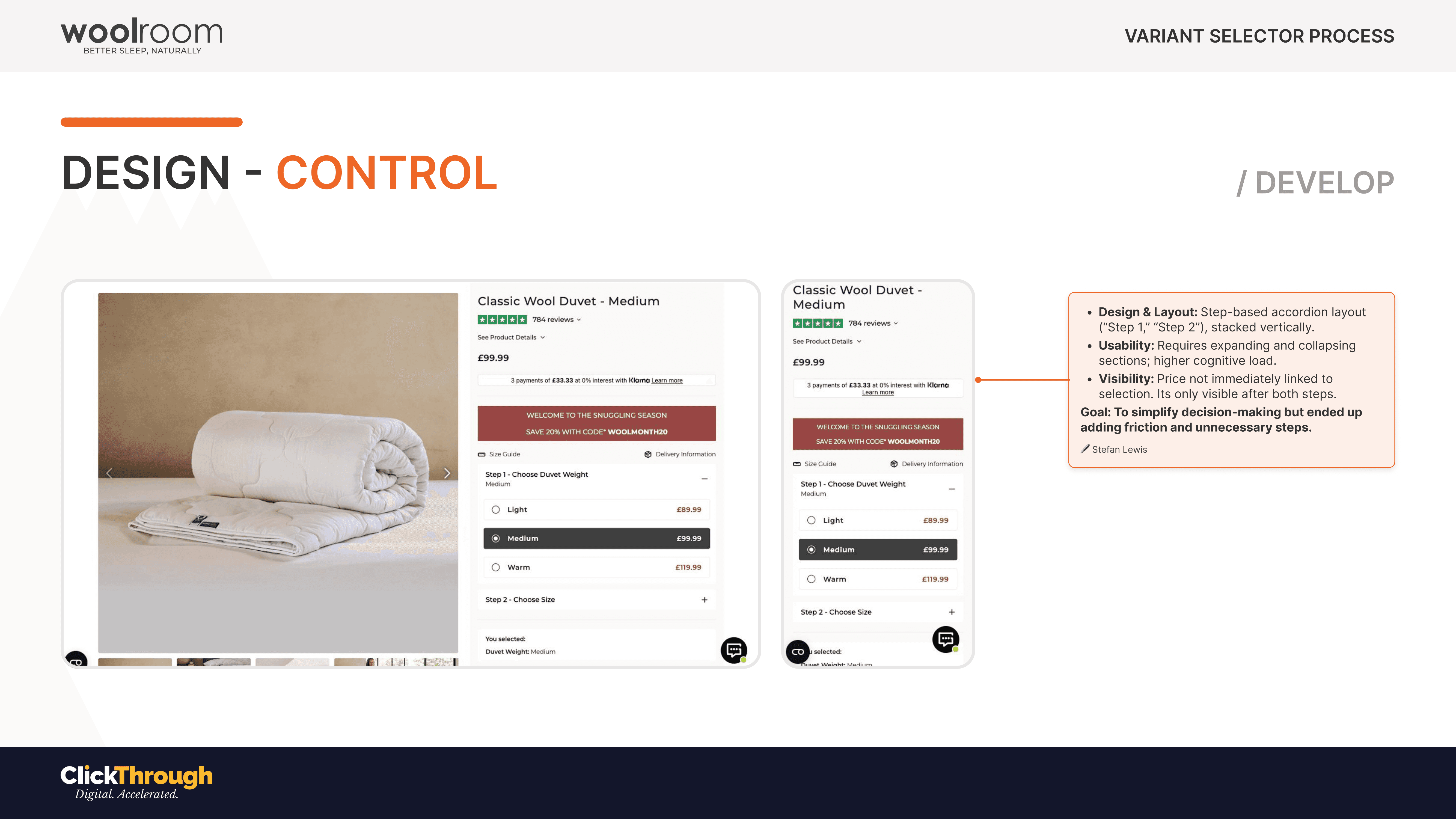
Example: Previous product page used collapsible panels to separate variant selections such as weight and size.
The redesigned variant selector surfaced all relevant options together, allowing users to view duvet weight, size, and pricing simultaneously within a clearer and more intuitive configuration layout.
Challenge :
One key challenge was Woolroom operating across three markets: the UK, US, and Canada. Each audience required slightly different UX approaches and experiment variations, which significantly increased design and testing workload. To manage this, I worked with my manager and the client to restructure the experimentation roadmap so we could prioritise the highest impact tests while maintaining delivery momentum.
Another challenge was balancing client requested tests with research driven hypotheses. Clients would sometimes request experiments based on internal opinions rather than validated data. I addressed this by advocating for evidence backed experimentation while still accommodating urgent client requests when necessary.
Result : Variant Selector implementation
View Website
The redesigned variant selection experience successfully outperformed the existing product page during live A/B testing. The new layout reduced friction in the product configuration process, improved visibility of pricing and product options, and created a more intuitive purchasing flow. As a result, Woolroom implemented the winning variation across their live website.
Key Takeaways :
Reduce Friction to Improve Conversion
Clear product configuration flows can significantly reduce friction in e-commerce purchasing journeys.
Data Should Guide Experimentation
Behavioural analytics combined with qualitative research leads to stronger CRO hypotheses.
Validate Design Through Real User Behaviour
Structured experimentation allows design decisions to be validated through real user behaviour rather than assumptions.
This is just a snapshot of the entire design process. Reach out for the full story!
Find out more
More Projects
UX & CRO Design
Woolroom UX/CRO Optimisation
Optimised Woolroom’s key conversion pages' experience through research driven UX and CRO experimentation to improve conversion, clarity, usability, and overall engagement.
Year :
2025
Industry :
Ecommerce
Client :
Woolroom
Project Duration :
2 months
Overview:
As a UX & CRO Strategist, I worked with Woolroom, a luxury bedding e-commerce brand, to improve conversion performance across key revenue pages. Using a combination of behavioural analytics, UX research, and experimentation, I generated and tested over 20 UX/CRO hypotheses. Each test focused on reducing friction, improving product clarity, and making purchasing decisions easier for customers across the UK, US, and Canadian markets.
This project demonstrates my ability to combine research, UX design, and experimentation to drive measurable business outcomes.
Objectives:
Reduce friction
Improve the product configuration experience by simplifying variant selection and surfacing important information earlier in the decision process.
Increase visibility
Ensure users could clearly see pricing changes and available options when switching between duvet variants.
0+
0+
UX/CRO hypotheses were created, client approved, and tested.
Key actions:
Conducted behavioural analysis using GA4 and session recordings to identify product page friction.
Designed and validated new UX patterns for variant selection and product configuration.
Led UX experimentation and A/B testing to validate improvements before full deployment.
From left to right, this is the UX /CRO process I took for each client:
Behavioural Data Analysis
Analysed GA4 and Microsoft Clarity data to understand how customer interaction and identify friction points.
UX Heuristic Evaluation
Conducted heuristic reviews of revenue generating pages to uncover usability issues and conversion barriers.
Qualitative Research
Developed personas, user journey maps, surveys, and competitor reviews to understand purchase motivations.
Hypothesis Generation
Converted insights into structured CRO hypotheses and prioritised them using expected impact and effort.
Design & Experimentation
Created multiple UX design variations and tested them through offline preference testing across Woolroom’s UK, US, and Canadian audiences.
A/B Testing & Validation
Built and launched experiments using Varify to validate the winning design through live A/B testing.
Tools used:
Figma
GA4
Microsoft Clarity
Varify
Monday.com
Lyssna
Example: Previous product page used collapsible panels to separate variant selections such as weight and size.
The redesigned variant selector surfaced all relevant options together, allowing users to view duvet weight, size, and pricing simultaneously within a clearer and more intuitive configuration layout.
Challenge :
One key challenge was Woolroom operating across three markets: the UK, US, and Canada. Each audience required slightly different UX approaches and experiment variations, which significantly increased design and testing workload. To manage this, I worked with my manager and the client to restructure the experimentation roadmap so we could prioritise the highest impact tests while maintaining delivery momentum.
Another challenge was balancing client requested tests with research driven hypotheses. Clients would sometimes request experiments based on internal opinions rather than validated data. I addressed this by advocating for evidence backed experimentation while still accommodating urgent client requests when necessary.
Result : Variant Selector implementation
View Website
The redesigned variant selection experience successfully outperformed the existing product page during live A/B testing. The new layout reduced friction in the product configuration process, improved visibility of pricing and product options, and created a more intuitive purchasing flow. As a result, Woolroom implemented the winning variation across their live website.
Key Takeaways :
Reduce Friction to Improve Conversion
Clear product configuration flows can significantly reduce friction in e-commerce purchasing journeys.
Data Should Guide Experimentation
Behavioural analytics combined with qualitative research leads to stronger CRO hypotheses.
Validate Design Through Real User Behaviour
Structured experimentation allows design decisions to be validated through real user behaviour rather than assumptions.
This is just a snapshot of the entire design process. Reach out for the full story!
Find out more
More Projects
UX & CRO Design
Woolroom UX/CRO Optimisation
Optimised Woolroom’s key conversion pages' experience through research driven UX and CRO experimentation to improve conversion, clarity, usability, and overall engagement.
Year :
2025
Industry :
Ecommerce
Client :
Woolroom
Project Duration :
2 months
Overview:
As a UX & CRO Strategist, I worked with Woolroom, a luxury bedding e-commerce brand, to improve conversion performance across key revenue pages. Using a combination of behavioural analytics, UX research, and experimentation, I generated and tested over 20 UX/CRO hypotheses. Each test focused on reducing friction, improving product clarity, and making purchasing decisions easier for customers across the UK, US, and Canadian markets.
This project demonstrates my ability to combine research, UX design, and experimentation to drive measurable business outcomes.
Objectives:
Reduce friction
Improve the product configuration experience by simplifying variant selection and surfacing important information earlier in the decision process.
Increase visibility
Ensure users could clearly see pricing changes and available options when switching between duvet variants.
0+
0+
UX/CRO hypotheses were created, client approved, and tested.
Key actions:
Conducted behavioural analysis using GA4 and session recordings to identify product page friction.
Designed and validated new UX patterns for variant selection and product configuration.
Led UX experimentation and A/B testing to validate improvements before full deployment.
From left to right, this is the UX /CRO process I took for each client:
Behavioural Data Analysis
Analysed GA4 and Microsoft Clarity data to understand how customer interaction and identify friction points.
UX Heuristic Evaluation
Conducted heuristic reviews of revenue generating pages to uncover usability issues and conversion barriers.
Qualitative Research
Developed personas, user journey maps, surveys, and competitor reviews to understand purchase motivations.
Hypothesis Generation
Converted insights into structured CRO hypotheses and prioritised them using expected impact and effort.
Design & Experimentation
Created multiple UX design variations and tested them through offline preference testing across Woolroom’s UK, US, and Canadian audiences.
A/B Testing & Validation
Built and launched experiments using Varify to validate the winning design through live A/B testing.
Tools used:
Figma
GA4
Microsoft Clarity
Varify
Monday.com
Lyssna
Example: Previous product page used collapsible panels to separate variant selections such as weight and size.
The redesigned variant selector surfaced all relevant options together, allowing users to view duvet weight, size, and pricing simultaneously within a clearer and more intuitive configuration layout.
Challenge :
One key challenge was Woolroom operating across three markets: the UK, US, and Canada. Each audience required slightly different UX approaches and experiment variations, which significantly increased design and testing workload. To manage this, I worked with my manager and the client to restructure the experimentation roadmap so we could prioritise the highest impact tests while maintaining delivery momentum.
Another challenge was balancing client requested tests with research driven hypotheses. Clients would sometimes request experiments based on internal opinions rather than validated data. I addressed this by advocating for evidence backed experimentation while still accommodating urgent client requests when necessary.
Result : Variant Selector implementation
View Website
The redesigned variant selection experience successfully outperformed the existing product page during live A/B testing. The new layout reduced friction in the product configuration process, improved visibility of pricing and product options, and created a more intuitive purchasing flow. As a result, Woolroom implemented the winning variation across their live website.
Key Takeaways :
Reduce Friction to Improve Conversion
Clear product configuration flows can significantly reduce friction in e-commerce purchasing journeys.
Data Should Guide Experimentation
Behavioural analytics combined with qualitative research leads to stronger CRO hypotheses.
Validate Design Through Real User Behaviour
Structured experimentation allows design decisions to be validated through real user behaviour rather than assumptions.
This is just a snapshot of the entire design process. Reach out for the full story!
Find out more